Bayesian vs Frequentist Uncertainty in Sequential Decision Making
Bayesian updating handles sequential uncertainty better than frequentist methods.
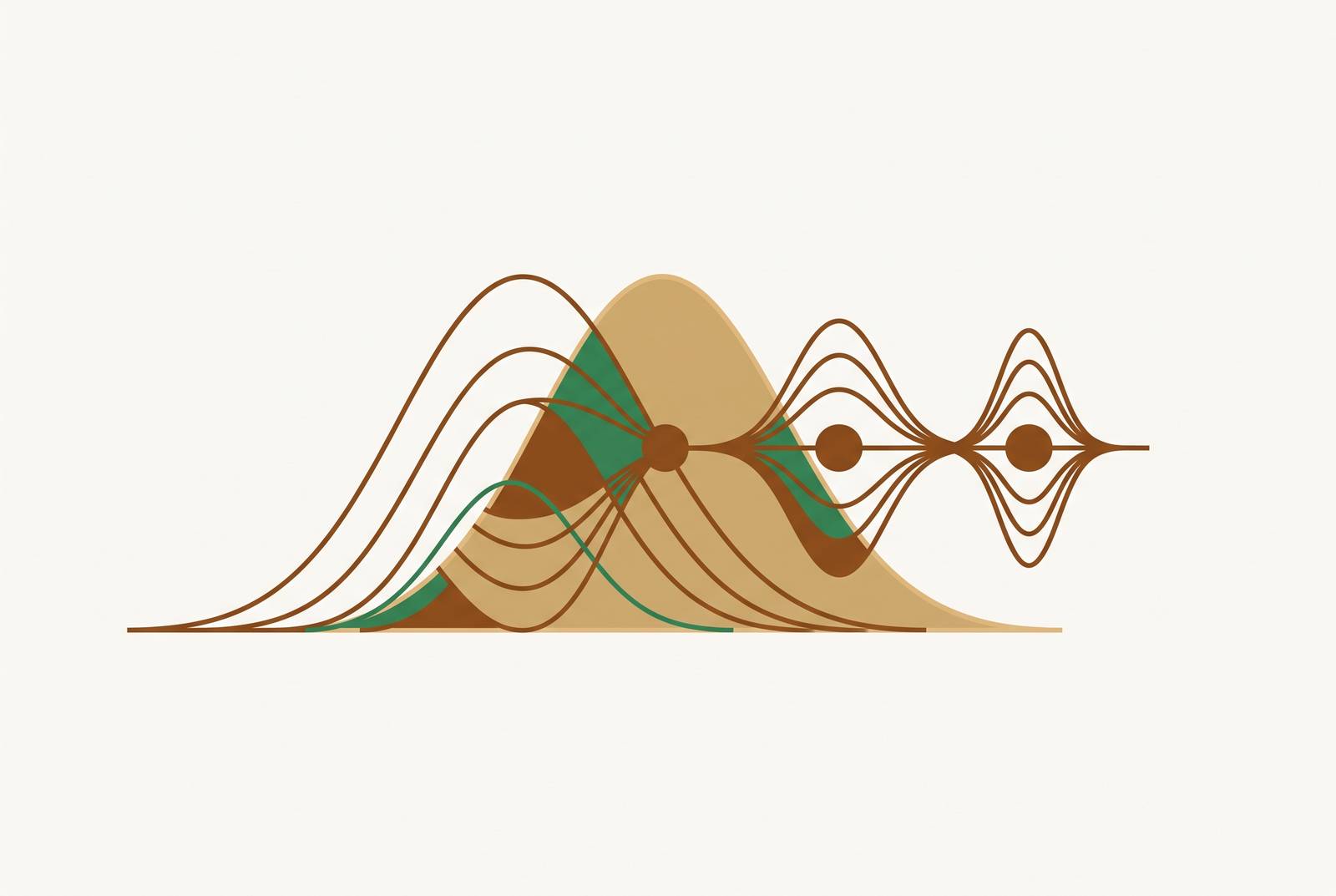
The disagreement between frequentists and Bayesians was never really about which formula to use. Frequentist probability is the long-run relative frequency of an event across an infinite sequence of identical, independent trials: objective, replicable, and silent on anyone's beliefs. Bayesian probability starts from a different place: it treats probability as a conditional degree of belief, a measure of how confident someone is in a claim given the evidence at hand, and that belief updates every time new data arrives, through Bayes' Theorem. In the Bayesian framework, a parameter is itself a random variable with its own distribution, which can shift as information accumulates.
The practical difference between the paradigms is visible in what each is willing to say. The posterior distribution, written P(θ | Data), is an updated belief about the parameter itself, and that single fact is what makes sequential updating coherent for Bayesians in a way it structurally cannot be for frequentists. Each new observation simply reshapes the posterior, which then serves as the input to the next round of reasoning.
None of this makes one paradigm correct and the other mistaken. This is a definitional gap, not a difference in computational convenience or software preference, and it is what matters for everything that follows. The gap between "frequency in infinite repetition" and "degree of belief given current evidence" is what drives every practical divergence between frequentist and Bayesian tools, especially once decisions have to be made in sequence rather than all at once at the end of a study.
What makes sequential decision making structurally different from a single inference problem
Sequential decision making is not just inference performed over and over. In a fixed-sample experiment, a researcher gathers all the data, then computes a result. In a sequential setting, someone, or some system, has to carry a live representation of current uncertainty, update it with each new data point, and turn it into a decision at every step along the way. That requirement changes what "handling uncertainty" even means.
Three distinct kinds of uncertainty stack up in these systems, and Lee et al., writing at FAccT '26, propose this breakdown as a common vocabulary for diagnosing sequential decision systems: model uncertainty, which concerns what actually governs outcomes; feedback uncertainty, since the result of an action never taken is never observed; and prediction uncertainty, which comes from working with finite samples. Feedback uncertainty deserves particular attention because it is not noise that averages out with more data. An agent testing one arm of a bandit problem cannot know what reward the untried arm would have delivered. That gap in observation is permanent, and no amount of additional sampling can close it.
The stakes of ignoring this compound over time, and nowhere more visibly than in questions of fairness. The partially observable Markov decision process, or POMDP, generalizes the whole picture: when the true state of the world has to be inferred from noisy observations, the posterior belief over possible states becomes the only input that matters for every future decision. The agent optimizes over its beliefs about the world rather than the raw history of what it has observed.
Pre-commitment in frequentist sequential procedures versus Bayesian updating
Frequentist guarantees depend on the sampling plan being fixed before any data comes in, and sequential settings put that requirement under real strain. A frequentist confidence interval means that across many hypothetical repeats of the same design, a certain proportion of the resulting intervals would contain the true parameter. It makes a statement about the procedure across imagined repetitions, not about the particular decision facing someone right now, with the particular data they already have.
This is why peeking at accumulating data and stopping as soon as a result looks significant inflates the Type I error rate. Some of these tools, like asymptotic confidence sequences, allow continuous monitoring without needing the full schedule pinned down in advance, which is a genuine advance within the frequentist framework. Even so, it is a specialized fix layered onto the core constraint, adding design complexity rather than removing the need for commitment.
Bayesian updating sidesteps the problem by construction rather than by patch. The posterior is a complete summary of current belief at any given moment, and it stays valid at any point someone chooses to look at it. Feeding that posterior back in as the prior for the next update is not a workaround bolted onto the method; it is the method. None of this means stopping rules stop mattering for Bayesians. Which data get observed still shapes what gets inferred, no matter which framework is doing the inferring. But a Bayesian does not need to fix the stopping rule in advance for the posterior to remain a valid summary of belief, and that single difference removes an entire category of design constraint that frequentist sequential methods have to engineer around.
The exploration–exploitation trade-off and the paradigms' operational difference
Reinforcement learning and bandit problems make the philosophical gap concrete, because every sequential agent operating under uncertainty faces the same question at every step: act on what currently looks best, or spend effort finding out whether something better exists. Getting that balance wrong in either direction costs real reward, whether the setting is a clinical trial allocating patients to arms or a recommendation engine choosing what to show next.
The frequentist approach has no posterior to lean on, so it has to build a solution to this trade-off from scratch. The bonus itself has to be worked out and tuned by hand, because nothing in the frequentist estimate of a sample mean naturally expresses how much is still unknown.
Bayesian agents do not face this as a separate design problem, because the Bayesian conditionality principle already settles it. Exploration is not a second policy stapled onto exploitation; it falls directly out of choosing the action that maximizes expected utility under the current posterior. Thompson Sampling, the standard Bayesian bandit algorithm, makes this almost literal: for each option, it draws a sample reward from that option's current posterior distribution, then picks whichever option's sample came out highest. When the posterior is still wide, because little data has come in, the samples drawn from it vary more, so exploration happens on its own, without a separate rule telling the algorithm to go look elsewhere.
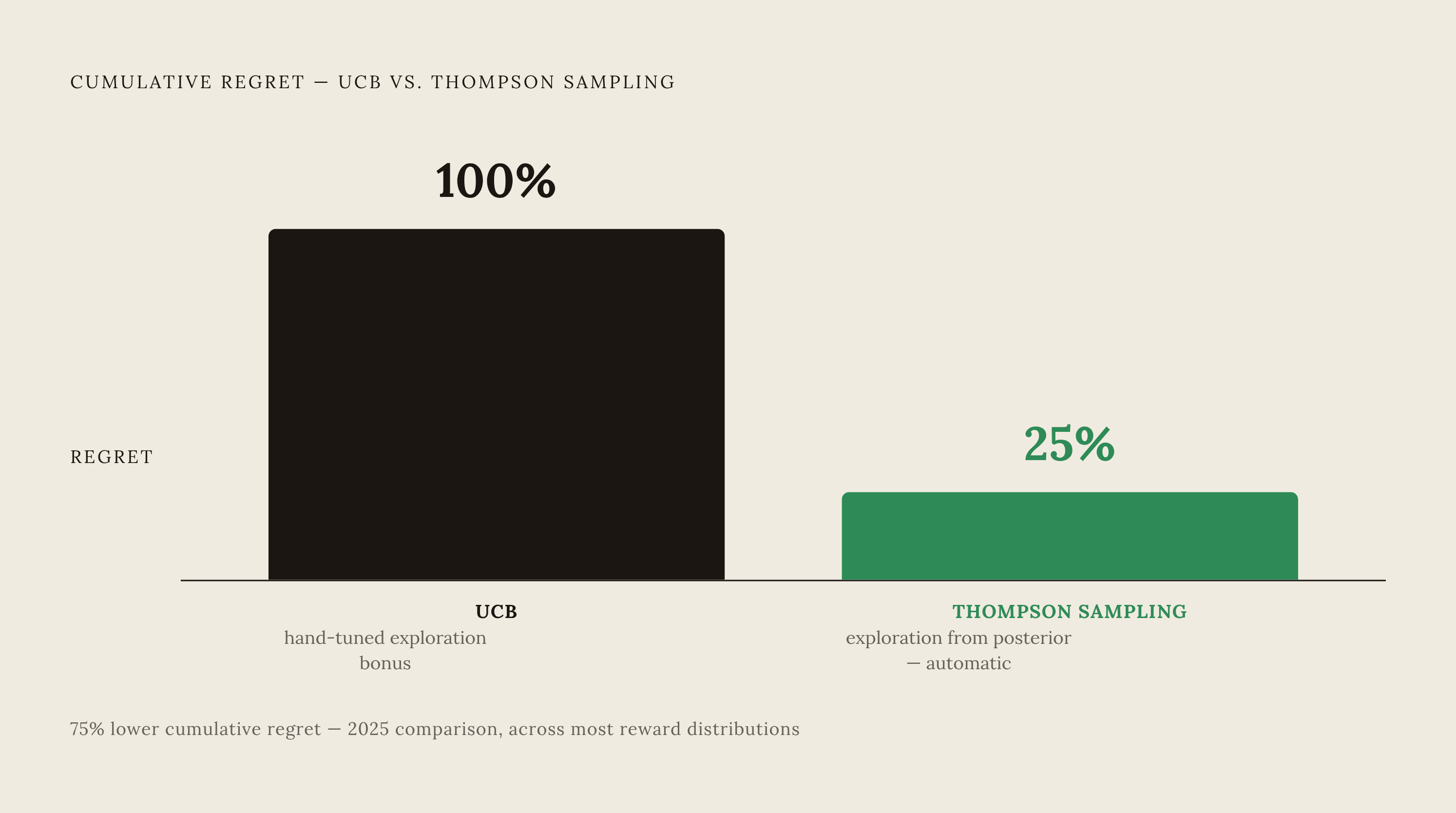
The two approaches are not merely different in style; they produce measurably different outcomes. A 2025 comparison of UCB and Thompson Sampling found that Thompson Sampling achieves substantially lower cumulative regret across most reward distributions, with a reduction of roughly 75 percent, and the gap widens most when reward distributions are skewed, high-variance, or otherwise irregular. The UCB exploration bonus has to be set by hand and is sensitive to getting that setting wrong. Thompson Sampling's exploration schedule comes from the prior and the data themselves, with no separate bonus term to tune.
Where Bayesian sequential methods carry real costs
The Bayesian advantages described so far come at a price, and the price is paid in computation, in sensitivity to assumptions, and occasionally in outright failure. Computing an exact posterior in Bayes-optimal reinforcement learning is only tractable in small, well-behaved toy domains. Step outside Gaussian processes and linear models, and exact posteriors give way to approximate inference, because the true calculation becomes intractable.
Approximation is not a minor compromise. Thompson Sampling has been shown to produce linear regret, the worst-case outcome, under certain approximate inference settings. The theoretical guarantee that makes Thompson Sampling attractive does not survive contact with an approximate posterior if that approximation is poorly suited to the problem. Calling a method Bayesian does not guarantee that it behaves the way Bayesian theory promises.
Prior sensitivity raises a separate concern. From the frequentist side, this is a practical objection rather than a philosophical one: since both frameworks can be calibrated to control their operating characteristics, the real question is which one is easier to pre-register, audit, and defend to a regulator or a skeptical stakeholder. For a well-behaved reward distribution, where the UCB exploration bonus is simple to set correctly, the entire apparatus of specifying latent variables, likelihoods, and priors may add real overhead without buying much in return. These are the reason the choice between the two paradigms depends on the setting, not on which framework sounds more sophisticated.
Clinical trials as the domain where the structural difference has been most precisely measured
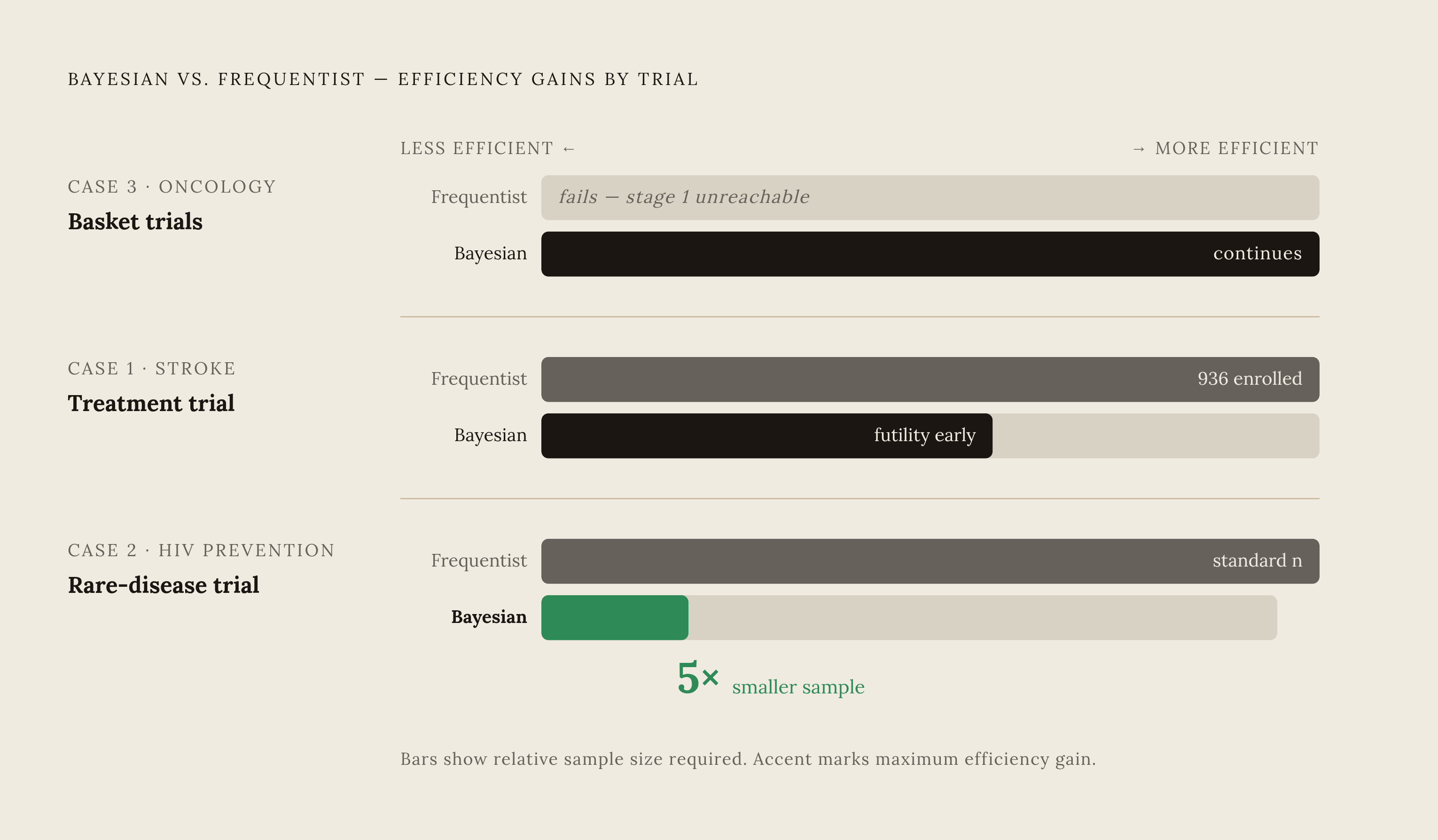
Clinical trials turn this entire debate into something measured in enrolled patients, and the record is detailed enough to show exactly where Bayesian sequential stopping earns its keep. In a large federally funded stroke treatment trial, a retrospective Bayesian reanalysis reached its futility conclusion several months before the frequentist design that was actually implemented reached the same conclusion, which only happened at 936 enrollments. That result stands as the clearest head-to-head case: the same trial, the same data, reaching the same scientific conclusion substantially earlier under Bayesian monitoring.
I-SPY 2, an oncology platform trial, uses adaptive Bayesian randomization across eight biomarker-defined subtypes, with ten biomarker signatures used to assess efficacy, and has graduated multiple drugs to Phase III testing as a result.
The clearest case for Bayesian efficiency may be a trial aimed at preventing mother-to-child HIV transmission in a rare-disease context. Documentation on PubMed shows this approach cut the required sample size by a factor of five compared to a standard frequentist design, precisely because historical data was abundant while the population available to enroll was too small to support a conventional trial.
Oncology basket trials, studied in one published comparison, compare Simon's two-stage frequentist design against Bayesian predictive probability monitoring. The frequentist design has to treat each tumor histology as its own independent trial, which breaks down when a rare indication cannot even reach the sample size required for its first stage.
Across these cases, a consistent pattern holds: Bayesian designs gain the most ground when defensible prior information exists, when the patient population is small or recruitment is slow, and when the decision structure is too complex to pre-specify every monitoring point in advance. Frequentist designs remain the regulatory default for confirmatory trials for a straightforward reason: they are easier to audit and pre-register. Any gain in sample efficiency that a Bayesian design offers has to be weighed against the burden of justifying the prior to a regulator who was not involved in choosing it.
FDA formalization of Bayesian sequential stopping
A 2026 FDA draft guidance addresses Bayesian methods in drug and biologic clinical trials directly, signaling that Bayesian sequential stopping is moving from a tolerated exception toward a recognized methodology even in confirmatory trials, the highest regulatory bar in drug development. Confirmatory trials have historically required frequentist group-sequential designs because their error-rate control is transparent and fixed before the trial begins. The SHINE trial result, in which the Bayesian design met its futility criteria at 800 enrollments while the frequentist design needed considerably more patients to reach the same threshold, is the kind of evidence that the draft guidance, referenced in arXiv:2601.14701, appears to be responding to.
The shift should not be mistaken for a reversal of frequentist standards. The FDA is normalizing Bayesian methods as an available option, not requiring them, and the burden of auditing a trial and justifying its prior to reviewers has not gone away. For anyone designing a trial, that changes the calculation: the work of specifying and defending a prior becomes a one-time regulatory investment rather than a standing obstacle with no clear payoff.
Agentic AI systems as the emerging domain where Bayesian sequential control has no frequentist equivalent
The newest arena for this divide is the control layer sitting inside LLM-based agentic systems, the part of the system responsible for routing requests, deciding when to stop, choosing which tool to call, and allocating a limited budget of compute or API calls across a sequence of actions. That control layer is a sequential decision problem under uncertainty in exactly the sense this article has traced from the start, and Bayesian decision theory offers it a natural home, while frequentist sequential tools have no comparable foothold there yet.
The distinction matters because an LLM by itself is a predictive model: given an input, it produces a plausible next output. An agentic AI system is something built on top of that, a decision-maker that uses the LLM as one component among several, deciding not just what to say but what to do next, whether to call a tool, whether to ask for more information, or whether to stop and return a result. In high-stakes deployments, the bottleneck is whether the system around the model can track its own uncertainty about the state of a task across many steps and act accordingly, which is precisely the sequential structure described throughout this piece, down to the posterior-as-sufficient-statistic logic of the POMDP framework.
No comparable frequentist toolkit has emerged for this setting, because there is no natural equivalent of a pre-specified sampling plan when the "trial" is a single agent working through an open-ended task with tool calls, retries, and budget constraints that shift as the task unfolds. A Bayesian belief over the state of the task, updated after every tool call or retrieved document, gives the control layer a coherent way to decide when to keep gathering information and when to act, the same mechanism that makes Thompson Sampling work in a bandit problem. Firms building orchestration systems for agentic AI, Phantom Farm among them, are approaching this control problem from a Bayesian footing for exactly this reason: the alternative is not a rival frequentist framework waiting to be adapted, but the absence of a framework.
Sources
- Bayesian sequential decision-making for rare disease clinical trials - PubMed
- Fairness under uncertainty in sequential decisions
- Bayesian and frequentist approaches to sequential monitoring for futility in oncology basket trials: A comparison of Simon’s two-stage design and Bayesian predictive probability monitoring with information sharing across baskets
- (PDF) Comparison of Regret in Ucb Algorithms and Thompson Sampling Under Different Reward Distributions
- Regulatory Expectations for Bayesian Methods in Drug and Biologic Clinical Trials: A Practical Perspective on FDA's 2026 Draft Guidance
- Comparison of Bayesian vs Frequentist Adaptive Trial Design in the Stroke Hyperglycemia Insulin Network Effort Trial - PMC