Causal Inference Integration With RL for Decision Support
Bridging the gap between pattern-spotting and true causal reasoning in high-stakes decisions.

Reinforcement learning can optimize a policy from logged trajectories, but it can't explain why the policy works, and it can't say if it will keep working once conditions change. That gap between a system that spots patterns and a system that understands cause and effect is what keeps RL out of medicine, energy grids, and any setting where a wrong policy costs a life or a contract. Causal reinforcement learning tries to close that gap by building the machinery of causal inference, structural causal models, do-calculus, causal graphs, directly into the RL loop, so the agent reasons about interventions and counterfactuals instead of just averaging over whatever it happened to see. Anyone still treating causal RL as an academic curiosity rather than a prerequisite for deploying RL in medicine is behind where the evidence already sits.
Why pure RL fails at consequential decisions
An RL agent learns from state-action-reward trajectories. It watches what happened, updates a policy to make good outcomes more likely, and repeats. No matter how many layers of neural network drive that process, correlational learning is what comes out the other end. Judea Pearl's ladder of causation puts pure observation on rung one, intervention (doing something and watching what happens) on rung two, and counterfactual reasoning (asking what would have happened under a different action) on rung three, and that framing makes the limit obvious. Standard RL operates above pure observation, but the agent still can't answer a counterfactual question without an explicit causal model behind it.
Confounding produces that gap, and it is visible in three distinct ways once real stakes enter the picture. An agent with no structural prior about its environment has to learn everything from scratch, including facts a human expert could have handed it in one sentence: plain sample inefficiency. Hidden variables that shaped both past decisions and past outcomes get baked into the learned policy, and nothing in the data alone flags the distortion: confounding. And a policy tuned to one environment can fail the moment conditions shift in ways the training data never captured, often with no warning until after the failure: distribution shift.
Pearl has argued for years that this isn't a minor engineering gap to patch later, but a ceiling. Without explicit causal modeling, he contends, no amount of scale or compute gets a system to the kind of general, adaptable reasoning that open-ended, high-stakes environments demand. Not everyone in the field signs onto every part of that claim, and it's fair to treat it as a strong position rather than settled consensus. But sample inefficiency, confounding, and brittle generalization appear reliably enough in deployed RL systems that dismissing the argument takes more than a shrug.
What causal reinforcement learning is
Causal reinforcement learning, CRL for short, is a family of methods that inject causal knowledge, structural causal models (SCMs), do-calculus, causal directed acyclic graphs (DAGs), into some part of the RL pipeline: how the agent models its environment, how it evaluates a candidate policy, or how it searches for a better one.
The core move swaps the standard decision-process model for a causal variant built around a structural causal model. Instead of treating state transitions as a black box to be learned by trial and error, CRL models the process generating those states with a causal graph, then lets the policy reason directly over that graph.
That buys the agent three things pure RL doesn't have. A causal graph narrows the search space and gives an explicit chain of reasoning behind a decision instead of a black-box weight matrix, so the agent's choices become legible rather than just correct or incorrect by luck. Causal relationships also hold steady across environments that differ only in surface statistics, while correlational patterns snap the moment the distribution shifts, and that's the actual mechanism behind generalization, not some side benefit. On top of that, the agent gains counterfactual access: the ability to ask what would have happened under a different action, instead of only ever averaging over trajectories it actually observed.
The field has moved past scattered papers into something more settled. A 2026 arXiv treatment, "An Introduction to Causal Reinforcement Learning" (arXiv:2606.24160), lays the subject out in textbook form, complete with accompanying slides. Someone sitting down to teach a field systematically, rather than rushing out the next incremental result, is usually a sign the field has cleared its early, scattershot phase.
How causal structure is built into a learning agent
Two distinct routes get causal structure into an agent, and they're not interchangeable. The first assumes the graph is already known: a domain expert, or prior scientific literature, hands the agent a DAG or SCM, and that structure constrains the policy search, steers exploration toward variables that actually matter, and gives a ready-made explanation for why the agent picked the action it picked.
The second route has the agent find the causal structure itself, through interaction. Shengyu Zhu and colleagues' "Causal Discovery with Reinforcement Learning" (ICLR 2020) was early, influential work here, treating the search over possible causal graphs as its own RL problem. Ordering-based causal discovery, presented at IJCAI 2021, extended that line. In both cases, RL's own search machinery finds the causal graph, then hands it off to a downstream planner.
More recent work blurs the line between the two routes instead of keeping them apart. One 2025 approach, published online in October 2025 in Science China Information Sciences (a Springer Nature co-published journal), folds causal structure updating directly into the RL interaction loop through active intervention learning. The agent doesn't discover a graph once and act on it forever. The agent and the causal model update together as new interventions come in, which is a meaningfully different design than the discover-then-plan pipeline above.
A separate strand ties causal reasoning to hierarchical RL specifically. "Hierarchical Reinforcement Learning with Targeted Causal Interventions" (ICML 2025) connects do-calculus formally to hierarchical policies, aiming interventions at specific levels of the hierarchy rather than treating the whole policy as one flat object to poke at.
Confounding: why observational data alone cannot be trusted
A confounded MDP is one where some unobserved variable shapes both the actions recorded in historical data and the future states and rewards that follow. Feeding that data into a standard off-policy method leaves the algorithm with no way to separate the confounder's effect from the policy's effect. It credits everything to the policy, because the policy is the only variable it can see.
Healthcare makes the mechanism concrete, and it's worth walking through slowly because this is the failure mode that matters most. A reward function built from observed vitals looks reasonable on its face. But unobserved patient characteristics shape both which treatments a patient actually received and how that patient's outcomes played out. Collecting more records or scrubbing for errors doesn't fix that. The distortion is structural: the thing skewing the estimate was never going to show up in the columns of a spreadsheet, no matter how carefully the spreadsheet was compiled.
That's what makes offline evaluation such a bind in high-stakes settings. Deploying a new policy live, just to see how it performs, is often unsafe or flatly against the rules, so off-policy evaluation from logged data becomes the only option on the table. But OPE hits a hard wall whenever the offline data doesn't reflect the distribution shifts a new policy would introduce. Ignoring confounding under those conditions doesn't just shave a few points off expected reward. In high-stakes settings like healthcare, running conventional offline RL against confounded data can produce decisions that are actively harmful, not merely suboptimal, because the policy has been trained to chase a signal that was never really there.
Technical solutions to confounded off-policy evaluation
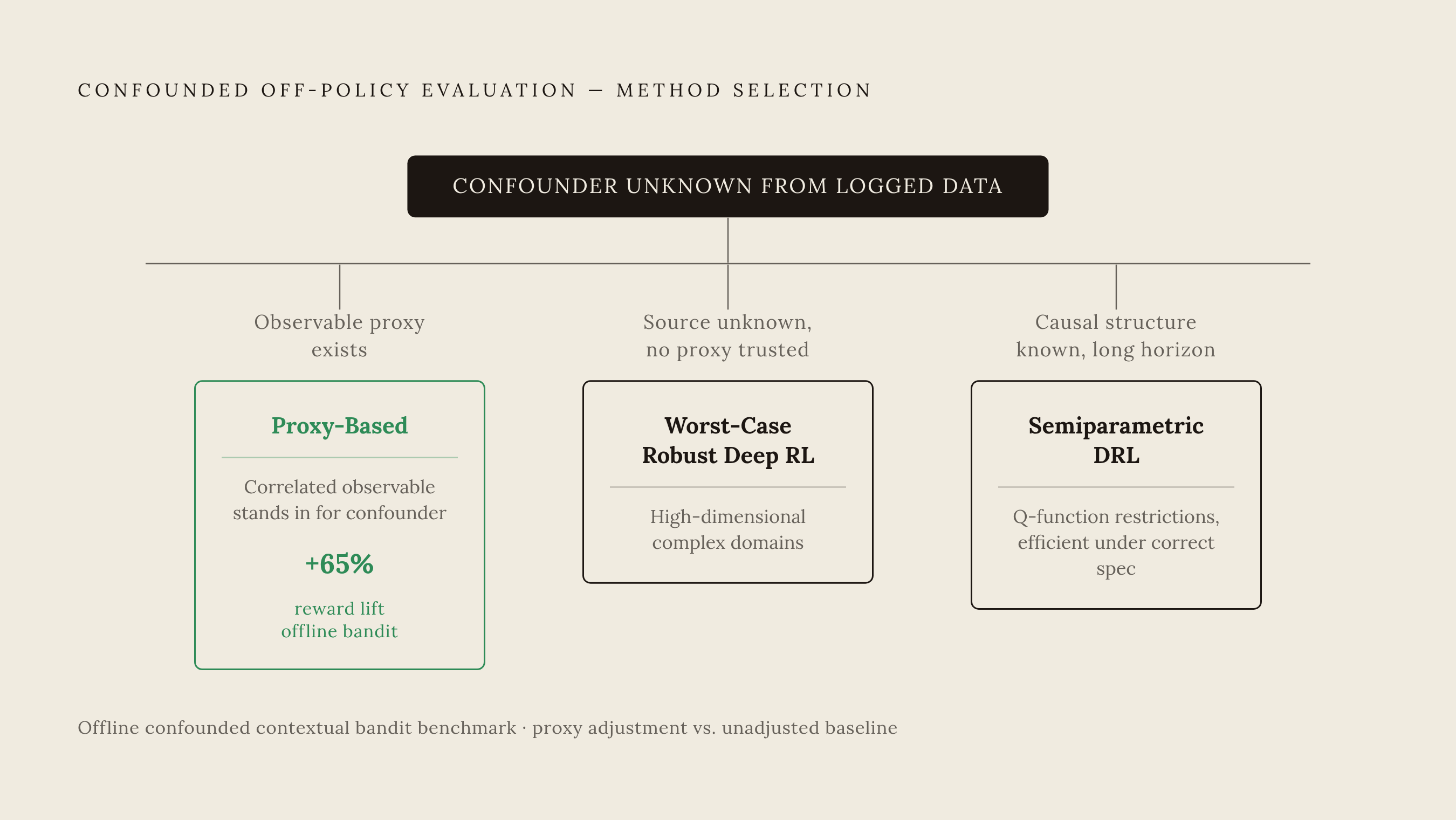
Three separate families of methods take this on, and none of them is a default choice you can reach for out of habit. Each answers to a different assumption about what you actually know about the confounder, and picking the wrong one for the situation is its own kind of failure, arguably a worse one than doing nothing, since it buys false confidence.
Proxy-based methods start from the idea that you may not observe the confounder directly, but you can often observe something correlated with it. Adjusting for that proxy variable produces a real correction: in offline confounded contextual bandit settings, proxy adjustment produces roughly 65% higher reward.
Worst-case robust deep RL takes the opposite stance. Rather than try to identify the confounder at all, it looks for a policy that stays safe under the worst environment consistent with what's been observed. This approach targets high-dimensional, complex domains where proxy variables may not exist or can't be trusted. Work from the Columbia Causal AI Lab, including "Automatic Reward Shaping from Confounded Offline Data" by Li, Zhang, and Bareinboim, along with a companion NeurIPS 2025 paper, "Confounding Robust Reinforcement Learning: A Causal Approach," pushes this line forward with a more explicit causal formalism behind the robustness guarantee.
A third approach, semiparametric double reinforcement learning (DRL), developed in work associated with van der Laan and colleagues, targets a narrower but important failure case. Fully nonparametric DRL turns unstable when overlap between time periods is weak and the occupancy ratios involved are high-dimensional. Semiparametric DRL places restrictions on the Q-function itself rather than on the reward and transition laws, which buys efficiency guarantees under correct specification and still holds up reasonably well when the specification is wrong. That property matters most for long-term causal inference drawn from randomized experiments, where the horizon runs long enough that fully nonparametric estimates start falling apart. A bandit-setting counterpart, "Counterfactual Structural Causal Bandits," is slated for ICLR 2026.
None of the three is a universal answer, and treating one as such is the mistake to avoid. Worst-case robust methods make sense when confounding is suspected but its source is unknown. Proxy methods make sense when some observable variable stands in for the hidden one. Full SCM-augmented DRL makes sense only when the causal structure is already reasonably well understood, and forcing it onto a problem where that structure isn't known is a common and avoidable mistake, one that tends to produce a confident-looking estimate that's wrong in exactly the way the method wasn't built to catch.
Distribution shift and generalization under causal invariance
Causal relationships stay fixed across environments that differ only in their marginal distributions. Spurious correlations don't. A policy that has learned the causal structure can tell a spurious pattern apart from a causal one. A policy that has only learned correlations can't, because from where it sits, a spurious pattern and a causal one look identical, right up until the environment shifts and one of them stops holding.
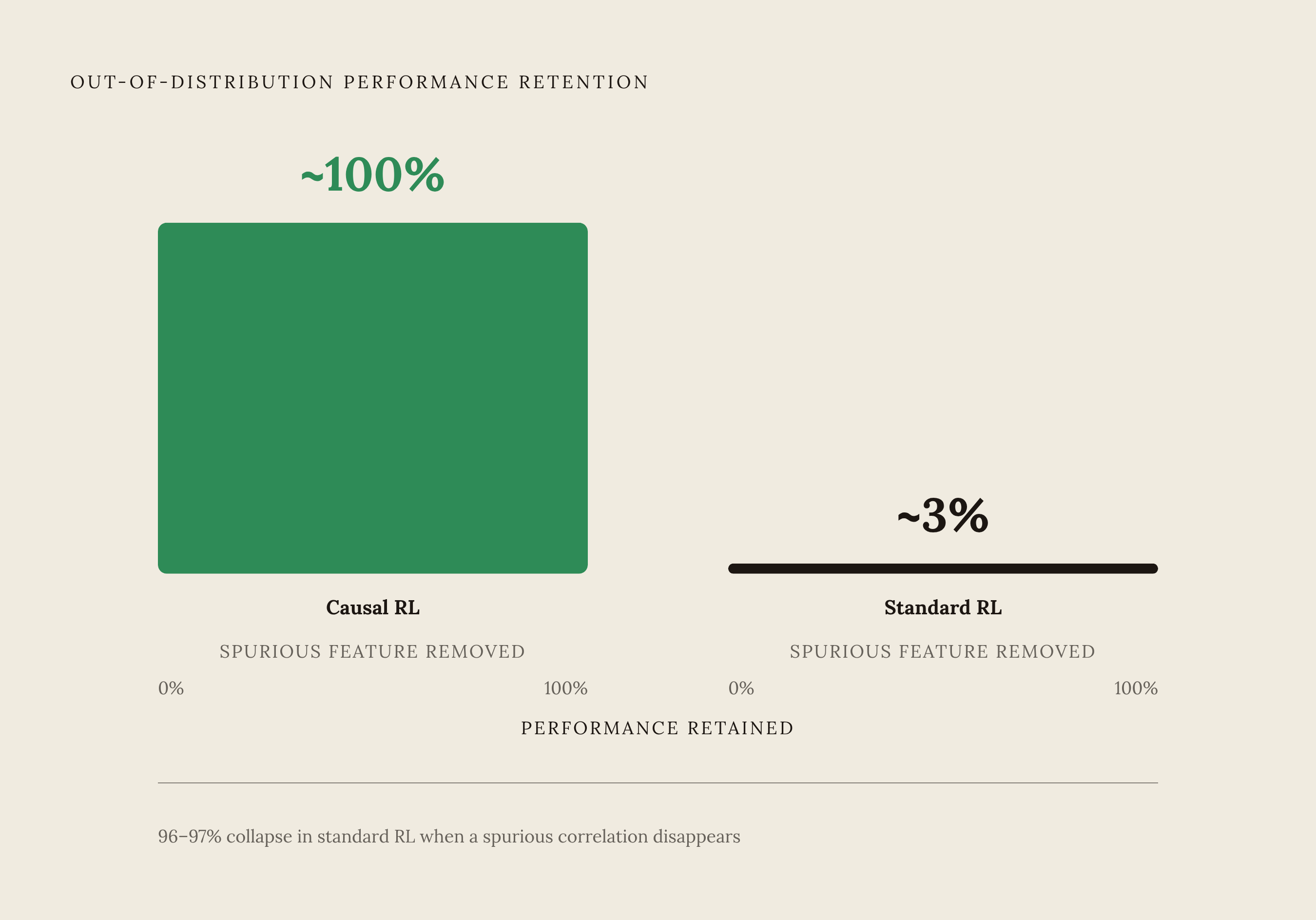
Benchmark results on feature-spurious CartPole variants make that gap concrete rather than abstract. Causal policies hold onto close to 100% of their out-of-distribution performance. Causal policies hold onto close to 100% of their out-of-distribution performance, while standard RL policies, trained on the same task, drop by 96 to 97%, collapsing the moment a spurious feature they'd leaned on simply disappears. A causal policy survives contact with the real world, while a standard RL policy doesn't.
Non-stationarity adds a further wrinkle: what happens when the causal structure itself changes over time, not just the surface statistics sitting on top of it? "Tackling Non-Stationarity in Reinforcement Learning via Causal-Origin Representation" (ICML 2024) takes that on directly, building representation learning that tracks the causal origin of an observation rather than its surface features, so the agent keeps pace with an environment whose underlying rules are moving under it.
TCIRL (arXiv:2609.07461) gives a sharp illustration of what's at stake when the shift is structural rather than distributional. In a genetic-therapy gridworld, the agent that infers a hidden temporal cause successfully triggers the phase transition and resolves the target condition. The agent without that causal inference stays stuck in Phase 1 indefinitely, chasing a reward signal that no longer describes the world it's acting in. The failure there traces to a hidden phase change in the underlying process, invisible to anything not explicitly modeling cause and effect.
Sample efficiency gains from causal structure
A causal DAG over state and action variables prunes the dependencies an agent has to weigh before it even starts learning. Pure RL has to discover, through trial and error, that some factor doesn't matter. A causally structured agent already knows it, because that factor was never in the graph to begin with. That distinction, discovering irrelevance versus starting from it, is where most of the efficiency gain in this whole research program actually comes from.
Data augmentation is a second lever, and the causal version of it differs in kind from the ordinary kind. "ACAMDA: Improving Data Efficiency in Reinforcement Learning Through Guided Counterfactual Data Augmentation" (AAAI 2024) and "Causal Action Influence Aware Counterfactual Data Augmentation" (ICML 2024) both generate synthetic transitions that respect the causal structure of the environment, rather than perturbing observed data in ways that might not correspond to anything the environment could actually produce.
Exploration itself can be pointed by causal knowledge too. "Boosting Efficiency in Task-Agnostic Exploration through Causal Knowledge" (IJCAI 2024) directs an agent's exploration budget toward actions carrying real causal influence over outcomes, cutting the wasted interactions that come from poking at dead ends a causal model could have ruled out ahead of time.
The most practically important result in this cluster says you don't need the whole graph to benefit, and that claim does more work than it might look like at first glance. "Partial Structure Discovery is Sufficient for No-regret Learning in Causal Bandits" (NeurIPS 2024) shows that a complete, fully specified causal graph isn't a prerequisite for efficiency gains. That matters because complete causal graphs are rare in the real world. Most domains only ever hand over partial structure, and lowering the bar for how much structure is required is what makes real deployment plausible rather than just theoretically nice.
Healthcare as the proving ground for causal RL in decision support
Healthcare is where this entire research program meets consequences that are hard to look away from. A systematic review covering RL-based clinical decision support systems from 2020 through January 2026 turned up 66 studies in total. The count by year ran one in 2020, then 10, 7, 16, 17, and 13 across 2021 through 2025, with 2 more so far in 2026: a field that moved from curiosity to active research program in a handful of years, and one that shows no sign of slowing down.
The dominant application areas, critical care, cardiology, oncology, and diabetes management, aren't a coincidence. All four involve sequential treatment decisions made on top of observational electronic health record data, exactly the setting where confounding risk runs highest and where a wrong policy carries an immediate, physical cost rather than an abstract one.
Cardiovascular care has produced some of the clearest reported results. Drudi and colleagues applied RL to cardiovascular disease treatment decisions and reported a 20% reduction in heart failure mortality. Zhou and colleagues used RL to guide lipid-modifying therapy assignment and reported a 37% improvement in heart-related outcomes. Ghasemi and colleagues applied RL to coronary artery disease management and reported a 32% improvement in patient heart outcomes. Three research groups, three clinical subdomains, all converging on the same claim: RL-guided treatment sequencing beats the alternative by a wide enough margin to take seriously.
Sepsis and ICU care remain the field's canonical benchmark, and for good reason. Deep reinforcement learning, deep learning to represent the patient's EHR history, RL to optimize the sequence of actions layered on top, has been applied specifically to fluid and vasopressor titration for septic shock. That task compresses everything laid out above into one problem: a sequential decision made under confounding from variables no one recorded, where the cost of a wrong policy is measured in mortality, not conversion rate. Getting the causal reasoning right there is the entire point of building any of this. It's the entire point of building any of this.